

For a number of years now, the Educated by Nature team has been quietly following the journey of The Woodland Tribe in the UK. From tens of thousands of kilometres away in Australia, we’ve watched as they transform festival fields into pop-up adventure playgrounds, places filled with timber, tools, children, and possibility.
The scale of what they create, and the trust they place in children to build it, has always left us in awe. Their work stayed with us. We talked about it often. Could something like that exist here in Western Australia? What would it look like in our landscapes, with our communities?
For a long time, it was just a conversation, a dream of what it could be. An idea we circled back to again and again.
Because to make something like this real, we knew we’d need more than good intentions. We’d need an event. We’d need a reason to commit. A deadline that would turn “one day” into now.
That moment came when we were invited to collaborate with Guildford Grammar School at the Darlington Arts Festival in 2025. We didn’t hesitate. We said yes, and suddenly we were working to make this dream a reality.
Preparing the ground
In the lead-up to the festival, the abstract became tangible.
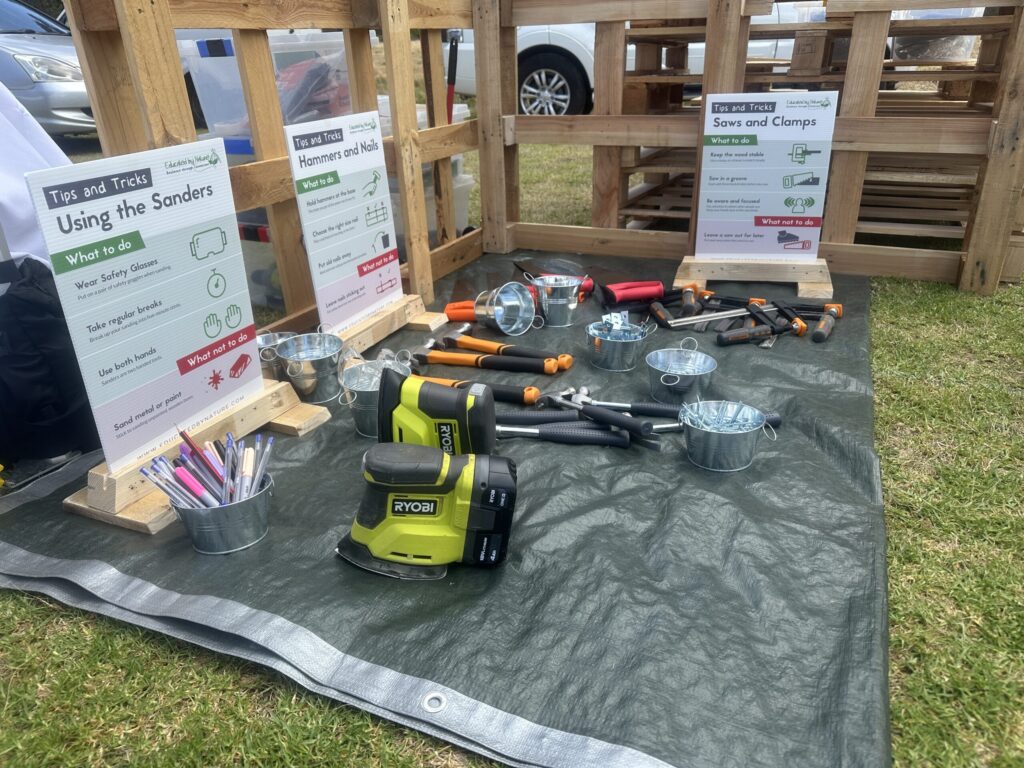
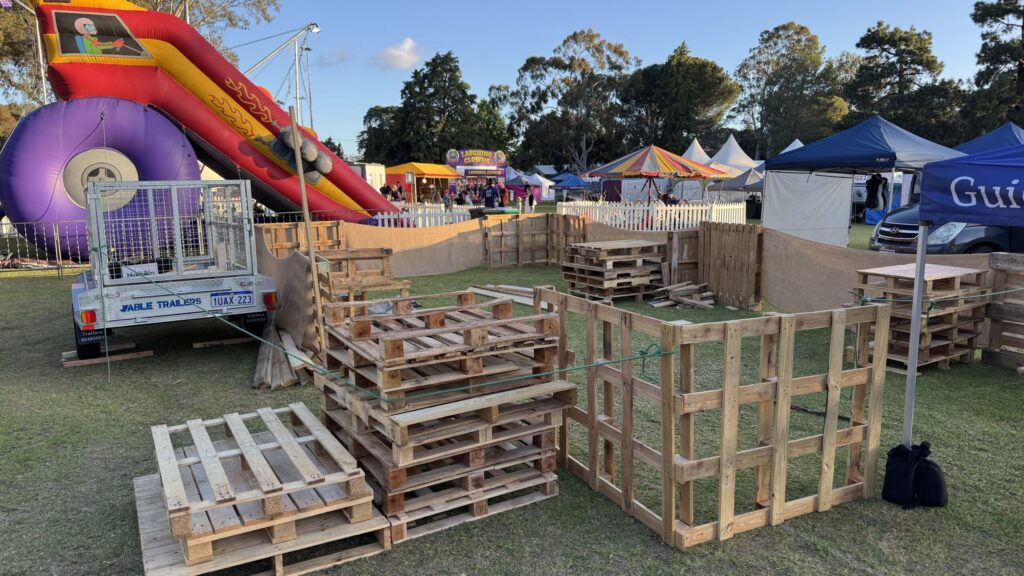
Pallets were collected and delivered to site. Tools were checked, sorted, and laid out. The space was roped off. Risk Benefit Assessments were done. Plans were made and then deliberately loosened.
As the festival slowly began to wake up around us, with music drifting through the trees and stalls taking shape, we stood back and looked at the space. For a moment, it was quiet. Full of potential. Waiting.
Day One: Spreading outward
As the first day progressed, Daniel and I watched the space change almost without us noticing.
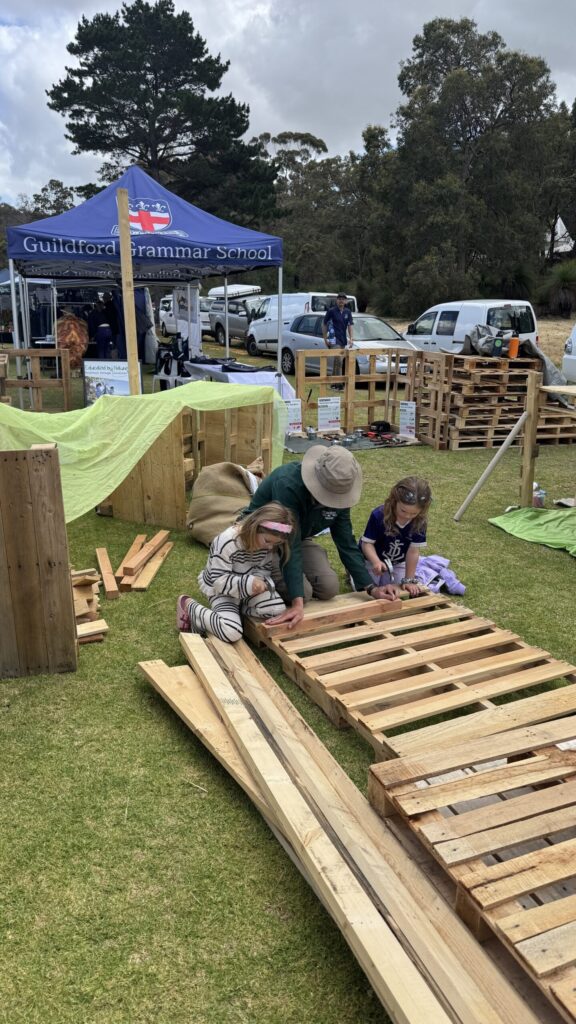
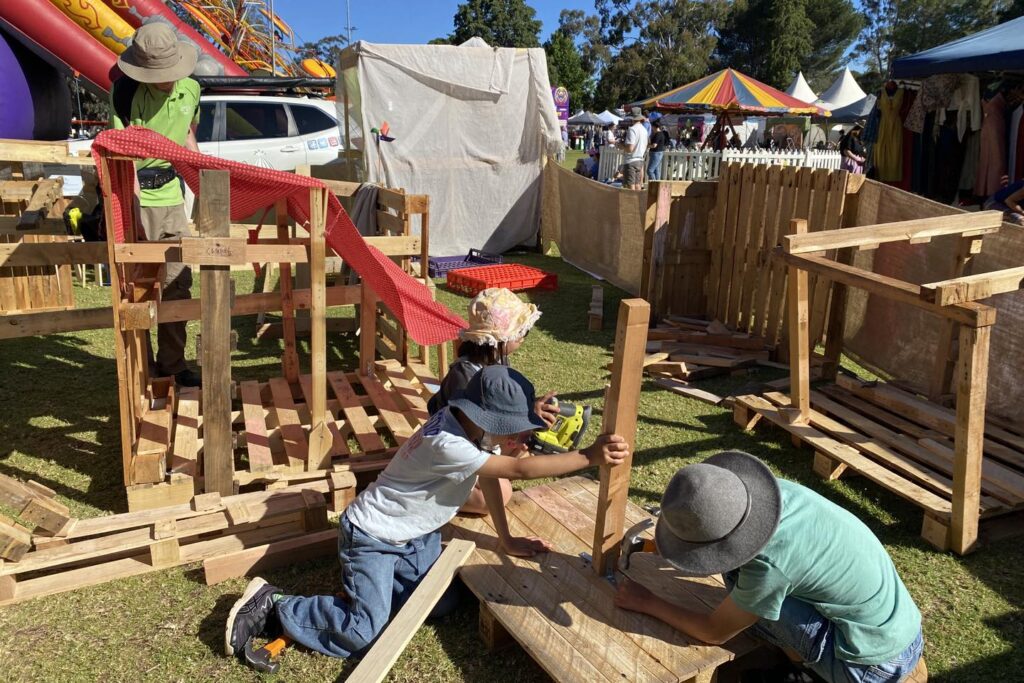
It began with singular cubbies tucked into the corners. Small, contained builds. Children working side by side, focused and careful. Then someone connected two of them. A flat tunnel system began to emerge, low to the ground, inviting movement through rather than over.
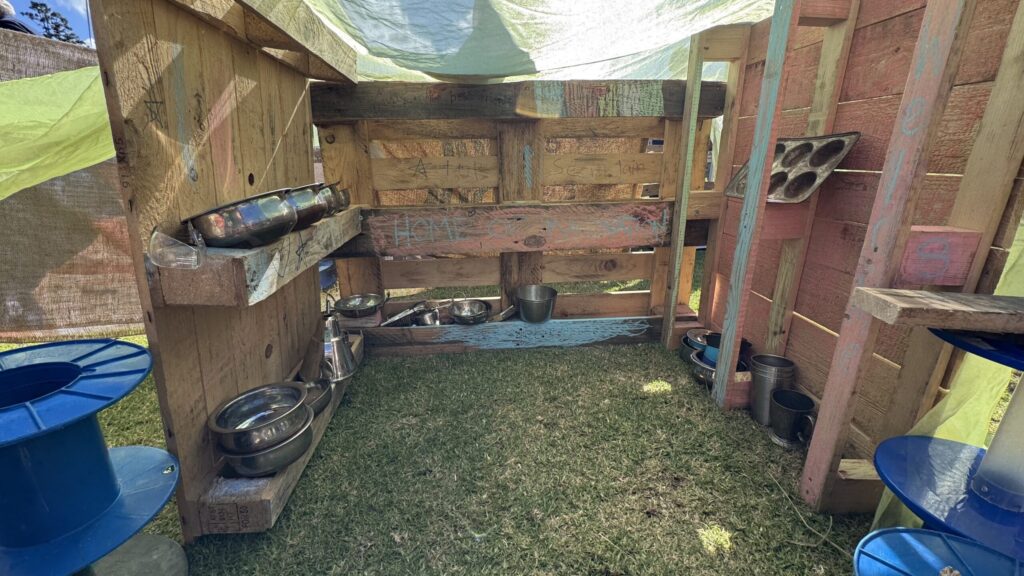
A kitchen appeared. Then shelves. Spatulas and utensils hung on the wall. Someone added a piece of fabric overhead and suddenly there was a roof. Children started building furniture, tables, benches, places to sit and gather. The walls of the cubby, once bare wood were decorated with chalk, words of kindness and affirmation.
As children left and new ones arrived, the tunnel system kept growing. Links were added. Corners softened. Pathways widened. What had started as individual cubbies became a shared, communal build.
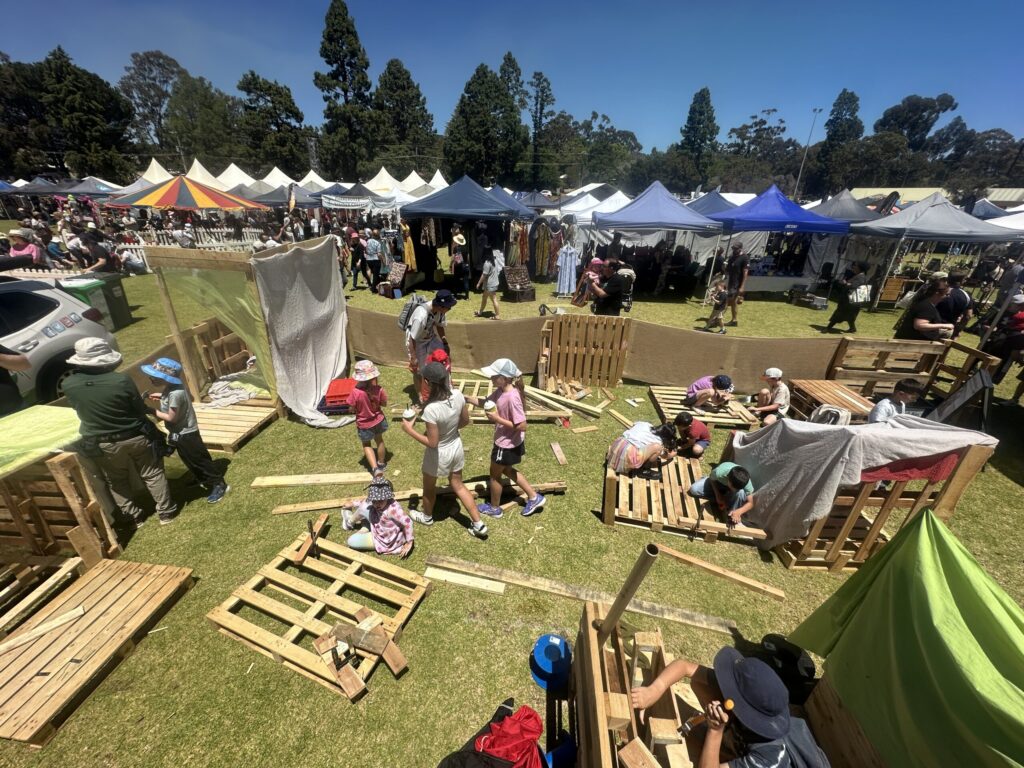
By mid-afternoon, the tunnels had spread across the small site, weaving between structures until they began to take over the entire space. It felt alive. Responsive. Always changing.
Children who had been there earlier in the day returned later, pausing before stepping in. They searched for familiar elements. Is my piece still here? What’s changed?
They pointed things out to parents. Remembered where they had worked. Noticed how others had built on their ideas. The village held memory. It told the story of everyone who had contributed to it.
Day Two: Reaching upward
On the second day, the same pallets, the same tools, and the same space were waiting.
But the feel was entirely different.
This time, Trudi and I watched height emerge.
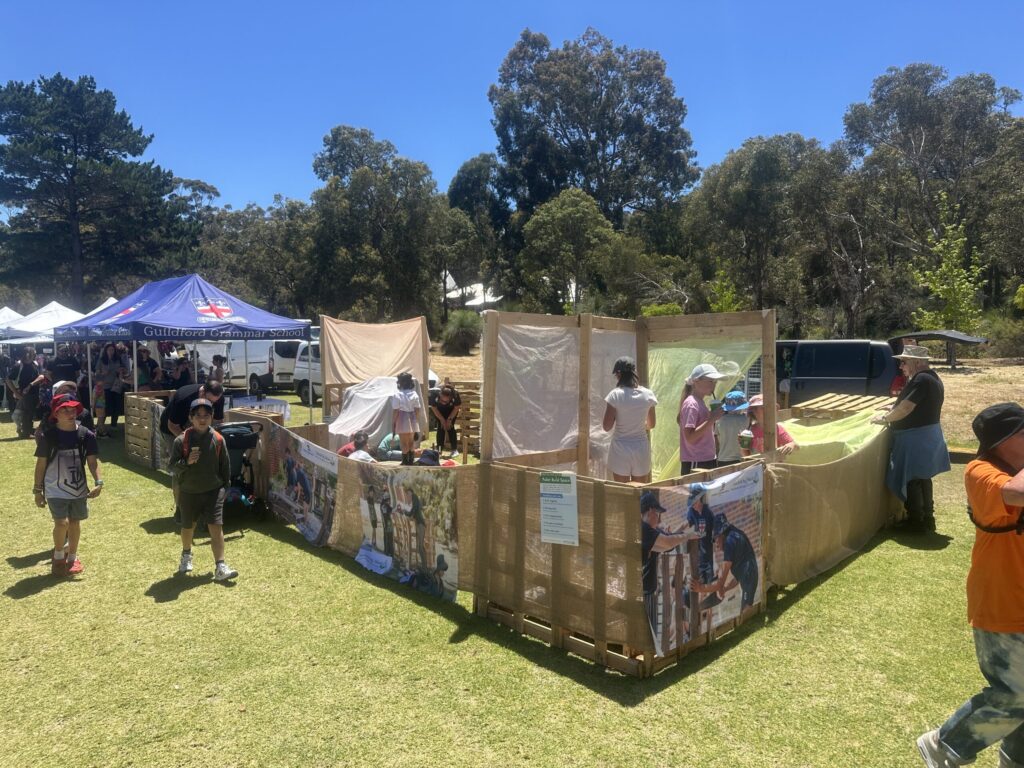
Structures grew tall enough to stand in and then to stand on. Second stories appeared. Ramps were built and adjusted. Platforms were tested, reinforced, and tested again. Children checked load-bearing strength, talked through ideas, and negotiated how high felt high enough.
Where the first day had been about connection across the ground, the second day reached upward. The village didn’t just change it evolved.
The same resources had invited entirely different kinds of thinking. The space felt more vertical, more architectural. Still playful. Still collaborative. But grounded in a deeper understanding of structure and risk.
Watching from the edges
Around the edges of the build space, parents watched the transformation unfold.
Some arrived cautious, unsure of what to expect, “he can’t use that saw, he is too young”. Others lingered longer than they’d planned, drawn in by the level of focus and collaboration they were witnessing. Children weren’t being told what to do. They weren’t rushing. They were absorbed. Supported by trained Playworkers who heard their ideas and wanted to find ways to bring them to life.
One mother stood for a long time, quietly watching her children move between structures, solve problems, and work alongside kids they’d never met before.
Later, she laughed and told us she was already planning how to source 20 pallets for her own backyard.
We love moments like that not because of the pallets, but because of the shift in perspective. When parents really see what their children are capable of when given time, trust, and real materials. Time. Space. Permission.
Risk, trust, and reality
Across the weekend, children used real tools. They lifted heavy timber, hammered nails, drilled screws, climbed, tested, adjusted, and tried again.
By the end of the festival only two bandaids had been used, both for very minor scrapes, and as expected everyone went home with all fingers and toes intact
What we witnessed wasn’t chaos. It was care. Children watching out for each other. Checking stability. Asking for help when they needed it. Navigating risk thoughtfully, with support rather than fear.
A long-held idea, finally moving
Much of what came to life at the Darlington Arts Festival has been shaped through our work with Year 7 students at Guildford Grammar School where pallet builds, tinkering, and adventure play have become powerful ways for young people to build confidence, connection, and trust in themselves.
Seeing this approach translate so naturally into a community festival setting felt significant. It affirmed something we’ve long believed: this kind of play doesn’t belong behind fences or timetables. It belongs in community spaces, where children of all ages can participate.
It was a culmination of years of ideas, learning, and logistics to make this experience possible. Watching it unfold, shaped by so many different children, across two very different days was something special, the facilitators left the days briming with excitement about the potential of programs like these.
As the weekend came to a close
As the festival wound down, the pallet village remained. A little uneven. A little chaotic. Completely full of story. As the children departed and the space was deconstructed there was an immense sense of pride in what had been achieved.
And just like that, something we’d been watching from afar for years had found its own place here in Western Australia. All it needed now was a name and more festivals to participate in.
Fast forward a few months and we are excited to introduce Re:Build. The name was a tricky one to land on but in the end Re:Build works as it reconnects children with their community, with their sense of play. the resources are recycled and reused, the space itself is reimagined and reconstructed as ideas are reinforced. We have three versions of Re:build that we are excited to share with the world, a 90 minute incursion, a long term consultation project and our festival and events version.
Get in Touch.
Does this sound like something your school, community group or event needs?
We can run Re:Build as an Incursion, Community Event or Consultation experience. Contact us to find out more, and organise a booking.