

Walking into Guildford Grammar School’s Year 7 Outdoor Learning Program this year felt less like arriving as a guest facilitator and more like returning to a community that Isaac and I have had the privilege of growing alongside. I’ve known many of these students since they were in Year 2 Bush School, and over the years we’ve continued working with them through further Bush School and Outdoor Learning Program experiences, as well as the Year 7 Self Build Play Space. That history mattered. It meant we weren’t beginning with introductions or explanations. We were building on years of trust, shared experiences and relationships that allowed us to get straight to what mattered most.
The Outdoor Learning Program itself is a carefully curated week of challenge, adventure and connection. Across the camp, students moved between archery, canoeing, crate stacking, bush hikes, tent camping and a range of experiences designed to strengthen resilience, independence and relationships with one another and the natural world. It is a program that asks young people to step beyond their comfort zones, work alongside one another and discover new capacities within themselves. The Guildford Grammar OLP team invited Isaac and me to contribute to this program by facilitating an experience that built upon the work we have been developing together through the Year 7 Self Build Play Space. It was a thoughtful inclusion that recognised play, making and tinkering not as something separate from outdoor education, but as another valuable way for teenagers to experience challenge, creativity, collaboration and growth.
An Invitation to Build
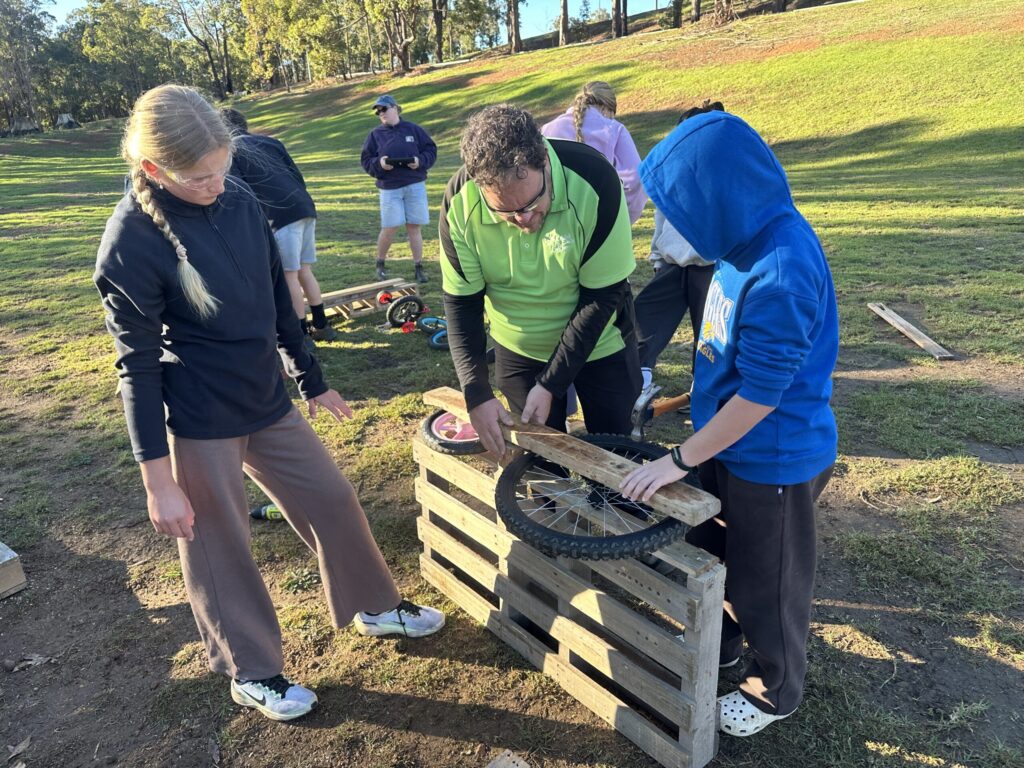
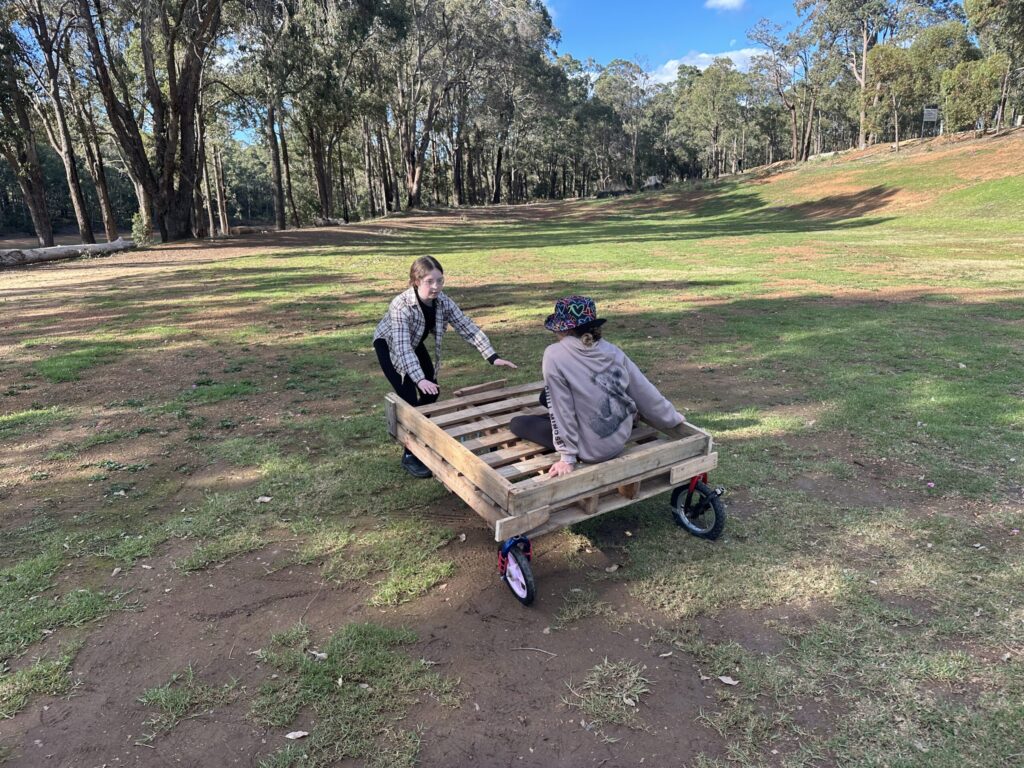
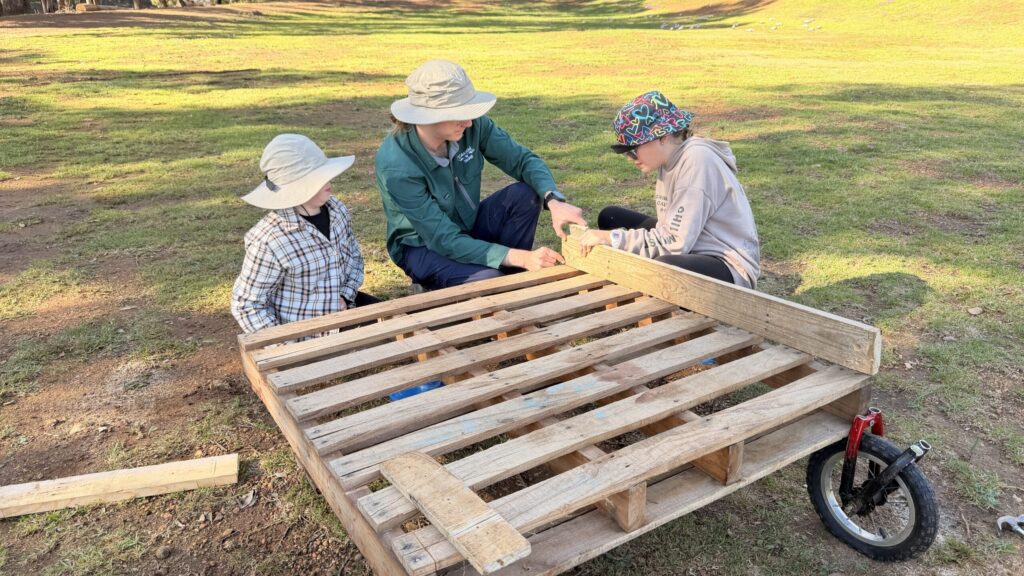
Our challenge for the camp was intentionally simple. We arrived with a truckload of pallets, a trailer full of wheels and a collection of power tools, and invited students to make something that moved. It could carry a person or it could carry nothing at all. It could be carefully engineered or completely experimental. The aim wasn’t to produce the perfect design, but to create enough possibility that students would begin exploring, testing ideas and solving problems together.
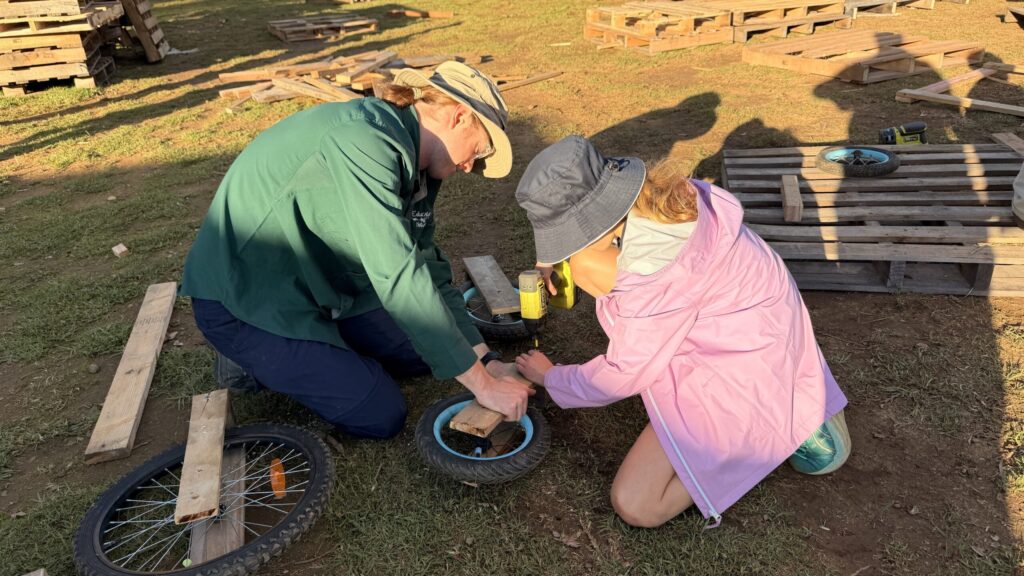
Before they started, we spent just a few minutes revisiting the expectations that come with working with real tools. The students reminded us about safety glasses, using power tools with two hands, looking after themselves, others and the environment, and making sure nails and screws weren’t left scattered across the grass. It was a short conversation because these weren’t new ideas. It was striking how familiar this all felt for many of the students. Those habits didn’t need to be taught again. They simply resurfaced as students picked up drills, safety glasses and timber, settling back into a way of working that had become familiar through experience. Once those expectations had been refreshed, we stepped back and allowed them to begin.
The Power of Open-Ended Play
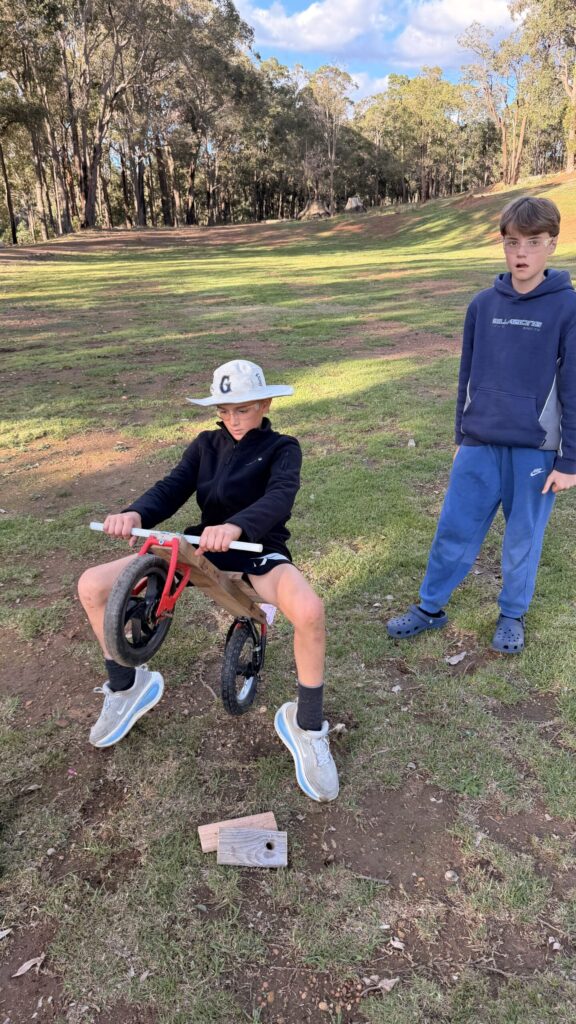
Over the week, the field beside the lake became a workshop full of possibility. Some students carefully planned before making a single cut, discussing wheel placement, weight distribution and how they might create a stronger frame. Others preferred to build through trial and error, attaching wheels, testing them immediately and adjusting their ideas as they went. Some worked in large groups while others partnered together or quietly pursued their own projects. A few students seemed far more interested in pulling things apart than putting them together, happily tinkering as they investigated old bike frames, axles and wheels before deciding what they wanted to create. Every one of these approaches felt equally valuable because the invitation was never about producing identical outcomes. It was about giving teenagers permission to explore and PLAY!
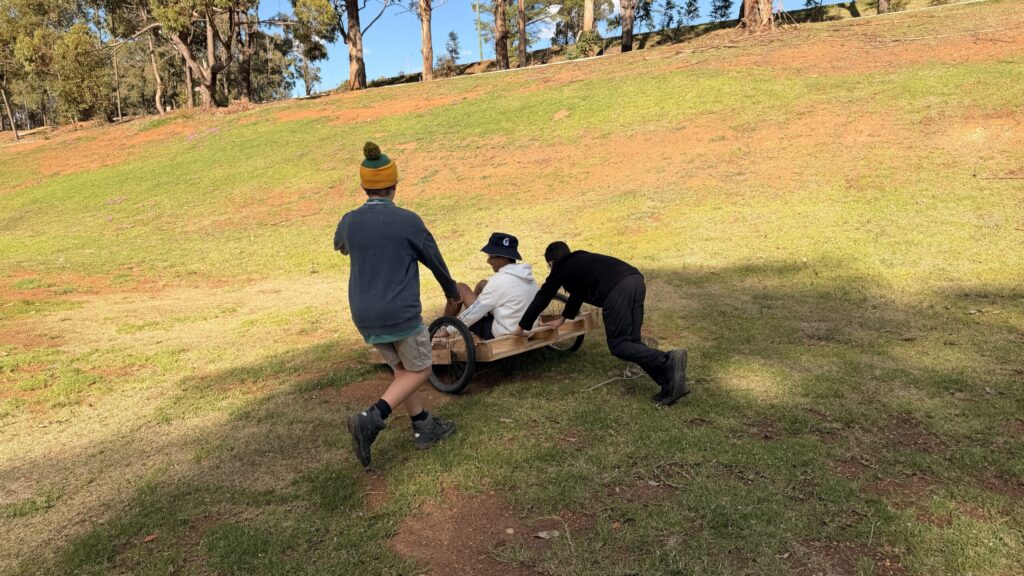
What struck me most wasn’t the finished creations, although there were some wonderfully inventive carts, trikes and wheeled contraptions. It was the confidence students showed when things didn’t work the first time. Wheels came loose, frames twisted, steering systems failed and creations rolled sideways instead of forwards, yet very few students saw these moments as failure. They simply became the next problem to solve. Timber was repositioned, screws tightened, ideas abandoned and new ones tested. Time after time, we watched groups drag their creations back up the hill for another attempt, not because anyone told them to keep going, but because they genuinely wanted to see whether the next adjustment would work.
That willingness to persist is one of the reasons I believe opportunities like this matter so much for teenagers. By the time young people reach secondary school, so much of their learning is shaped by timetables, assessment and the expectation that there is a right answer waiting to be found. Open-ended play becomes increasingly rare, yet adolescence may be the very time when it is needed most. Teenagers still need opportunities to tinker, experiment, collaborate, negotiate, make mistakes, discover what they are capable of and, perhaps most importantly, be trusted by adults to do all of those things.
Trusting Teenagers with Real Risk
As I stood back throughout the sessions, I couldn’t help noticing how naturally risky play emerged. Students worked confidently with power tools, lifted and manoeuvred heavy materials, tested their creations on the grassy slope (sometimes at great speed!) and constantly assessed whether an idea was safe enough to try. Others watched closely before deciding to have a go themselves, learning through observation as much as through action. None of this needed to be manufactured because the challenge itself contained enough uncertainty for genuine risk-taking to unfold. When young people are trusted with authentic materials and meaningful responsibility, they begin making thoughtful decisions about risk rather than simply avoiding it.
A Partnership Built on Shared Values
What I appreciated most about this experience was that it didn’t happen by accident. The ‘make something that moves’ challenge wasn’t simply an activity added to fill part of the camp timetable. It was included because the Guildford Grammar OLP team recognised the value of continuing the philosophy students have been experiencing through the Year 7 Self Build Play Space. It reflected a shared belief that teenagers benefit from opportunities to work with real tools, real materials and genuine responsibility, and that play, making and tinkering still have an important place in adolescent learning. Partnerships like this don’t emerge overnight. They grow through trust, shared values and a willingness to keep asking what young people might be capable of if adults create the space for them to surprise us.
Seeing Young People Differently
One of the great privileges of working in outdoor education is seeing young people reveal parts of themselves that don’t always appear in more traditional learning environments. During the week we watched students naturally step into leadership, quietly support friends who were feeling frustrated, solve complex problems together and celebrate one another’s successes. Their teachers were also able to see students through a different lens, noticing strengths that might otherwise remain hidden within the routines of everyday school life. Camps like these remind us that young people are wonderfully capable when we broaden our understanding of what learning can look like.
I’m deeply grateful to the Guildford Grammar Outdoor Learning Program team for inviting Isaac and me to be part of such a rich week. Their commitment to creating meaningful outdoor experiences gives students the opportunity to challenge themselves, strengthen relationships and connect with learning in ways that simply cannot be replicated inside a classroom. Just as importantly, it reflects a willingness to trust young people with authentic experiences rather than carefully controlling every outcome.
What Stays with Us
Watching a homemade cart finally roll down the hill certainly brought plenty of smiles, but it wasn’t the highlight of the week. The real value was found in everything that happened before that moment: the conversations around a pile of pallets, the failed ideas that sparked better ones, the students who spent time tinkering simply because they were curious, and the quiet persistence of dragging a creation back up the hill to try again. Those are the experiences that stay with young people long after camp is over. They remind me that play does not disappear during adolescence. It simply asks for different materials, different challenges and adults who are willing to trust.