

There are moments in education where something small catches your attention, and the more you sit with it, the more you realise it isn’t small at all. I recently came across a post about schools replacing “tardy slips” with “welcome passes.” At first glance, it feels like a simple rebrand. A softer phrase, perhaps. But if you pause and really listen to what each of those communicates, the difference is striking. One quietly signals that something has gone wrong, that a rule has been broken, that the day has begun on the back foot. The other opens the door. It says, without needing to explain itself, that you are still welcome here, that your presence still matters, that the story of your day hasn’t already been written.
From Duty to Support
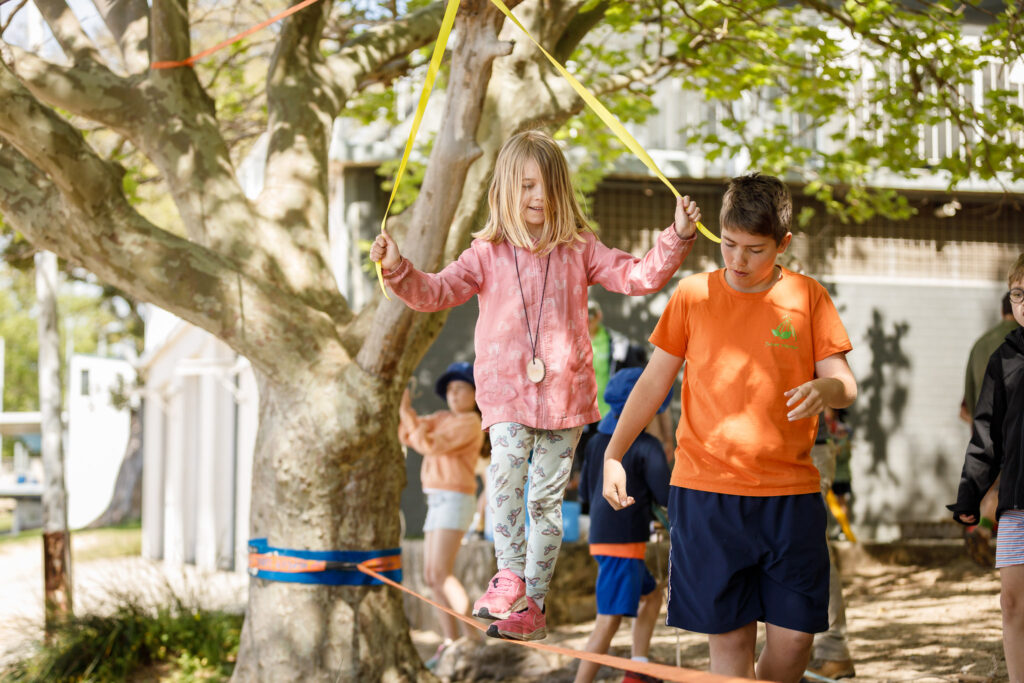
It took me straight back to a conversation with Cath Shaw, Principal at The Nature School in Port Macquarie. She shared something that has stayed with me ever since. At their school, they don’t use the term “yard duty.” Instead, they talk about “Play Support.”
It’s such a small shift. Two words, swapped out. But it lands differently in the body.
“Duty” carries a certain weight to it. There’s a sense of obligation, of watchfulness, of standing guard. It places the adult slightly outside the play, positioned as the one who oversees, manages, steps in when things go wrong. It subtly reinforces the idea that the playground is something to be controlled.
“Play Support” feels entirely different. It draws the adult in, not as a controller, but as someone who is there in service of something. It suggests presence rather than surveillance. Curiosity rather than correction. It asks, without saying it out loud, how can I help this play to continue?
And that shift in language begins to shape the way people show up.


Language as a Lens
You can imagine two educators stepping into the same space. One arrives thinking, “I’m on duty.” The other arrives thinking, “I’m here to support play.” The environment hasn’t changed. The children haven’t changed. But something in the posture, in the attention, in the readiness to intervene or to wait, begins to move in a different direction.
This is where language becomes more than just words. It becomes a lens.
So much of what we say in schools and early learning settings is inherited. Phrases that have been passed down, repeated so often that they feel natural, even inevitable. “No hat, no play” is one of those. It makes sense. It’s clear. It’s efficient. But it also centres the restriction. It defines the experience by what is not allowed.
When you hear “Yes hat, yes play,” something opens up. The expectation is still there. The boundary hasn’t disappeared. But the energy has shifted. It speaks to possibility rather than limitation. It quietly aligns the adult and the child on the same side of the equation. (Gratitude to Justine Moormon for sharing this one)
Where Culture Begins to Move
None of this is about lowering expectations. If anything, it requires more from us as adults. It asks us to be more intentional, more aware of how our words land, more considered in how we hold both accountability and dignity at the same time.
Because children are always listening, even when it doesn’t seem like it. They are taking in not just what we say, but how we say it, and what sits underneath it. Whether they are being seen as capable or as problems to be managed. Whether they belong, even when they’ve made a mistake.
Over time, these small shifts begin to accumulate. A different phrase here, a different tone there. An adult who pauses instead of stepping in. A moment where a child is invited into a conversation rather than shut down. None of it looks particularly dramatic from the outside. But collectively, it starts to reshape the culture of a place.
It’s easy to think that culture change requires something large and structural. A new program, a new policy, a complete overhaul. And sometimes those things have their place. But culture also lives in the quiet, everyday language of a setting. In the words that are spoken a hundred times a day without much thought.
So the question becomes less about what we need to add, and more about what we might gently shift. What are the phrases we use that carry assumptions we no longer agree with?
What language might be quietly positioning us as controllers rather than supporters? And what might change if we chose words that better reflect the kind of spaces we are trying to create?
Because sometimes, it really is that simple. Not easy, but simple. Change the words, and you begin to change the way we see and when we see differently, we start to act differently and that is where culture begins to move.
Want to read more?
Check out this blog on how adults can address barriers to outdoor and risky play for children.