

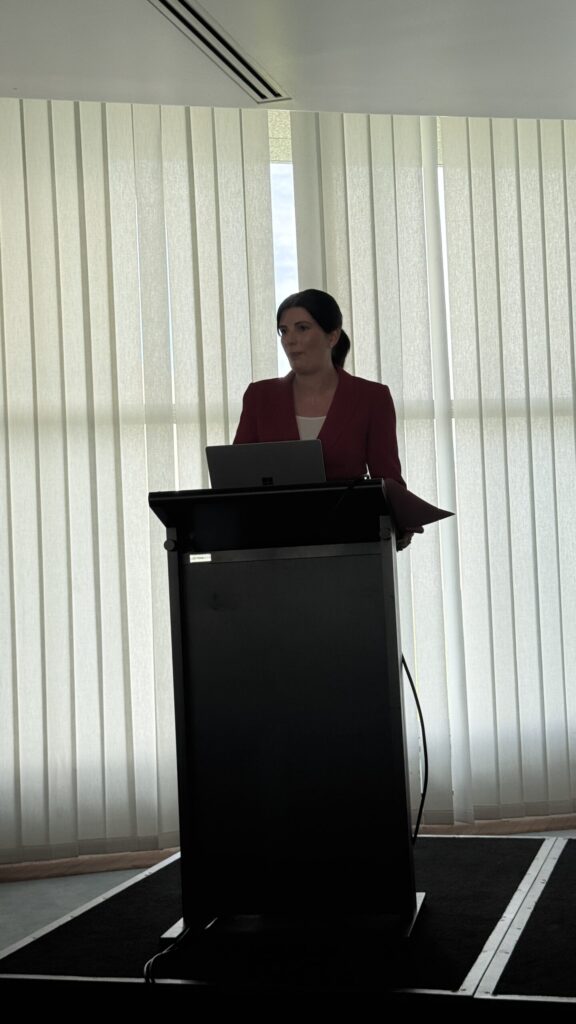
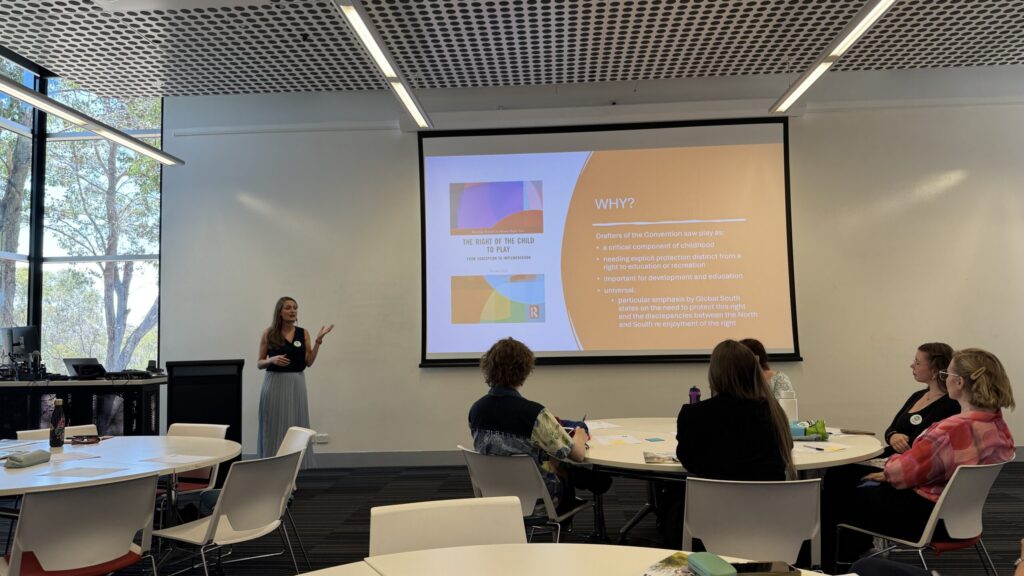
I recently attended the Australian Play Summit in Canberra. At the Summit, I had the privilege hearing Dr Naomi Lott’s presentation on Article 31 in the United Nations Convention on the Rights of the Child.
Article 31 states every child has the right to rest, leisure, play, and recreation. Supporting this right has been foundational to our organisation. It is referenced in our office, our workshops and our programs. It is a constant theme in conversations we have across the Playwork community, and anchors much of what we stand for.
Naomi’s, however, spoke about how play does not simply sit within Article 31. Rather, play underpins all of the rights. All 42 rights in the UNCRC are interconnected, and play threads through each one.
We regularly see this interconnectedness in our work. Through play, children exercise their other rights. They express their views and thoughts (article 12 and 13) through complex play scenarios that often mirror real-world tensions. They organise into groups and tribes, practicing their right to assembly (article 15). Cultural roots are explored and redeveloped as they draw in different practices to the games they make up (article 14). And perhaps most poignantly, when we make space for play, we support the ethos of the UNCRC – wellbeing for children.
Naomi explained that because UNCRC is international law, we do not need to wait for it to be domesticated into local legislation before we uphold it. Children already hold these rights. They are not aspirational, optional or dependent on adult convenience.
Creating a Rights-Conscious Generation
Listening to Naomi, it was obvious that as adults, this is where our responsibility deepens. Parents, teachers, early childhood educators, health professionals, transport planners, tourism operators, infrastructure designers – every adult whose decisions intersect with and shape children’s lives needs to understand these rights. They need be forefront in decision making, so that they are not accidentally infringed upon, or sidelined in the name of efficiency or safety or policy.
Back in Perth, Trudi and I were discussing the Summit. Talking about this responsibility, we realised something else: we also have a responsibility to teach children about their rights. If children don’t know they have these rights, how can they advocate for themselves? And, looking forward, what if every adult advocating for children had once been a child who deeply understood their own rights? What if rights education began early and stayed with them?
Supporting children’s rights requires a two-pronged approach. We need to educate adults now, so they can protect and uphold these rights, but we also need to educate children so that they can grow into adults who already carry this knowledge.
In the Australian Curriculum, Year 3 students explore laws, rights, and responsibilities within communities. Often, we focus heavily on the ‘responsibilities’ element of this curriculum content, asking questions like “What are your responsibilities at home, school and your community?”. These are important conversations, but there is also a powerful opportunity here to link rights and responsibilities directly to the UNCRC. An opportunity to unpack the fact that children are not only responsible members of communities – they are rights-holders within them. By empowering children to understand their rights, we set up a generation of adults passionate about protecting those rights for the children who come after them.
Increasing Awareness
As an organisation, we speak about the UNCRC regularly. We reference it in workshops and it is a frequent feature of our blog posts and social media engagement. However, we want to be more intentional with this going forward. We’ve made a commitment to include one or two UNCRC articles in every Educated by Nature newsletter across the year. We’ll clearly name and explain the rights, to share this knowledge with our community.
In our programs, alongside supporting these rights through making space for play, we’ve started opening conversations with children about their rights. By talking about their rights in everyday conversations, we support them to know and understand what rights they have, how they impact their lives, and how they can advocate for them. Through our voluntary work with the several play-based organisations, we facilitate this advocacy.
Sustainability
As Trudi and I reflected on the UNCRC, our conversation also wandered into sustainability. At the Sustainable Schools Alliance gathering, there was discussion about how sustainability – despite being a cross-curricular priority – is often undervalued in practice. This led us to consider the UN Sustainable Development Goals alongside children’s rights.
Through our work, we see these overlap. When we design spaces around children’s needs, we end up designing spaces that support local ecosystems as well. Natural materials lend themselves to sensory-rich, open-ended exploration, encouraging play but also reducing plastic consumption. Time outdoors, sit-spots and cubbies give children a place to unwind in nature, but also encourage a deep awareness and respect of the natural environment. We find our participants often self-police their peers, watching out for snapped tree branches or startled animals. What is good for children is often good for the environment.
There is also a convergence between children’s rights and environmental responsibility. Children have a right to safe, clean, healthy environments (article 24). We must look after the earth so that this can continue to be available.
Play Is Not an Extra
All of this boils down to one core belief for us: play is not an extra.
It is not something we “allow” once the “real work” is done. Play underpins development, health, participation, voice and connection. If Dr Lott is right, and I believe she is, it underpins every single one of the 42 rights outlined in the UNCRC.
We shouldn’t wait, children have these rights now. The question is whether we will uphold them, and whether we will ensure children know they hold them.
At Educated by Nature, we are committing to speaking about this more clearly and more consistently. We believe that when we protect play, we protect childhood. Through protecting childhood, we protect our collective future.