

A collective gasp rippled through the group gathered around the iPad.
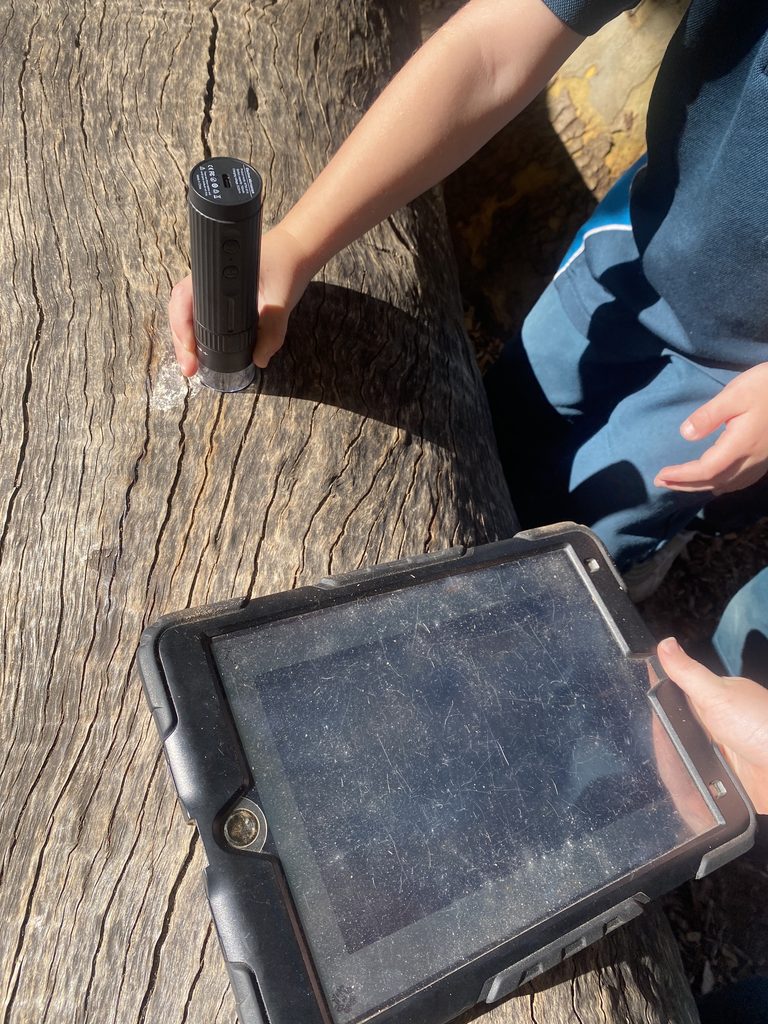
One child had carefully guided a digital microscope onto a tiny hole in a fallen log. For several weeks, the children had been experimenting with the microscope, learning what it could do, taking photographs and exploring its features through playful investigation. On this particular day, however, the microscope had become something more than a tool to experiment with. It had become a way of exploring a question.
What was hiding inside the hole?
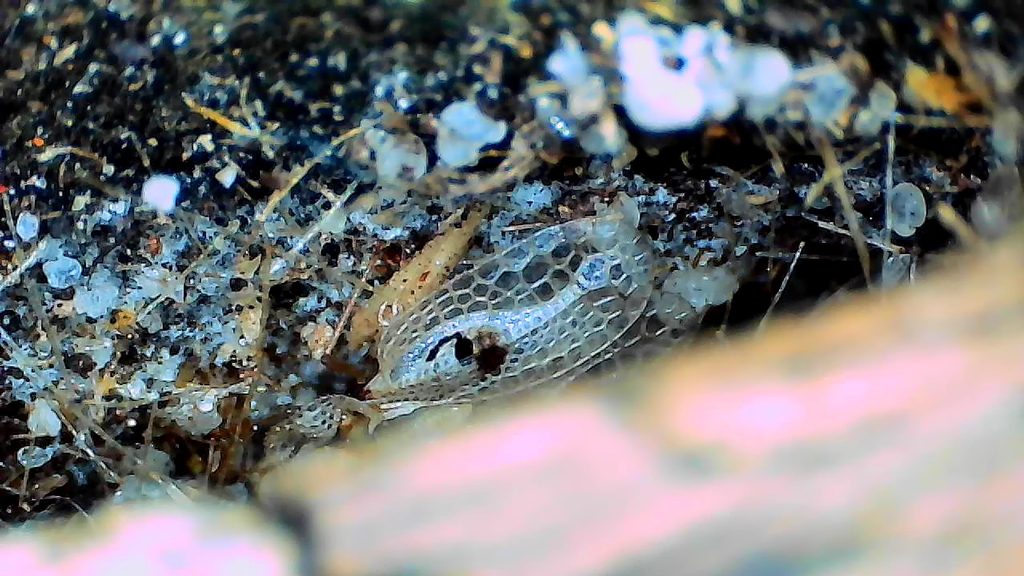
As the image came into focus, the children leaned closer. Patterns of colour and texture filled the screen. There were shimmering scales, rainbow-like reflections and winding lines. The group searched for words to describe what they were seeing before one child finally exclaimed, “It’s a snake skin.”
In an instant, the energy elevated as the children hooked onto the question of how a snake skin came to be in the hole.
The microscope moved from hole to hole as children searched for other hidden treasures. They discovered feathers, seeds, crystals and tiny details that had previously gone unnoticed. Children who had been exploring elsewhere drifted over to join the investigation. They slowed down. They lingered. They returned to the same holes again and again.
At first, it was the technology of the microscope and the iPad that held their attention, but now it was the mystery.
Drawn Towards Uncertainty
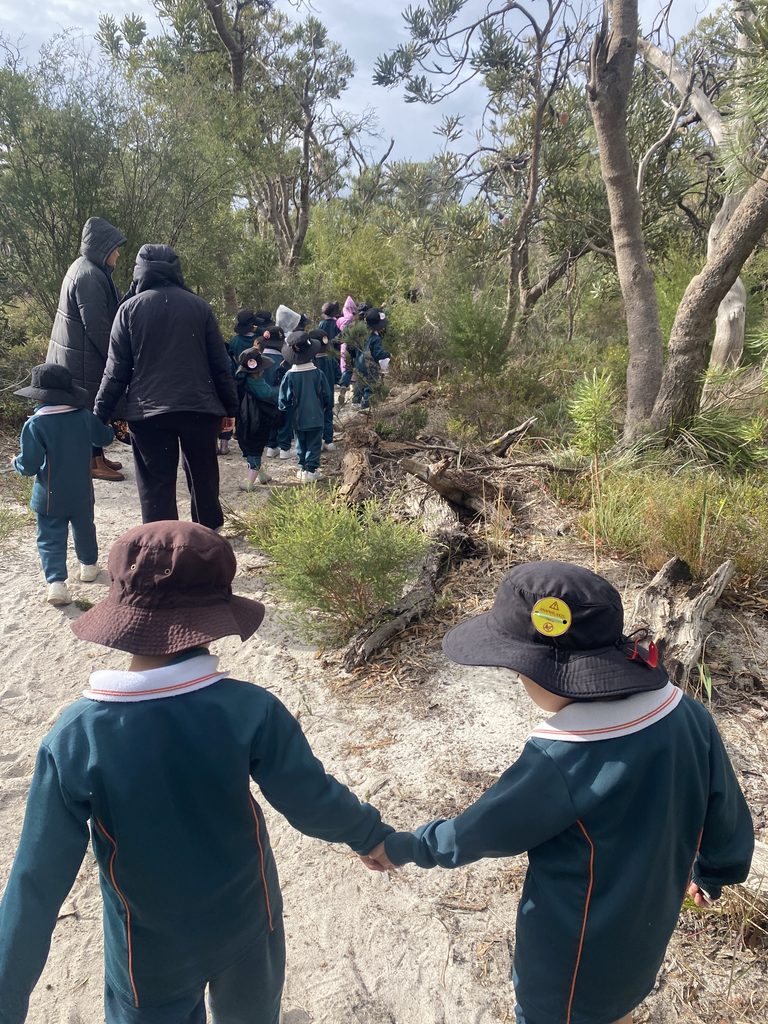
This term, through the Nature Connection Series supported by AISWA, we have been working alongside children and educators in three schools. Across very different settings, we found ourselves returning to the same observation. Again and again, children seemed drawn towards places that held a degree of uncertainty. Not uncertainty that overwhelmed them, but uncertainty that invited them closer.
We wondered whether mystery itself might play an important role in children’s relationship with place.
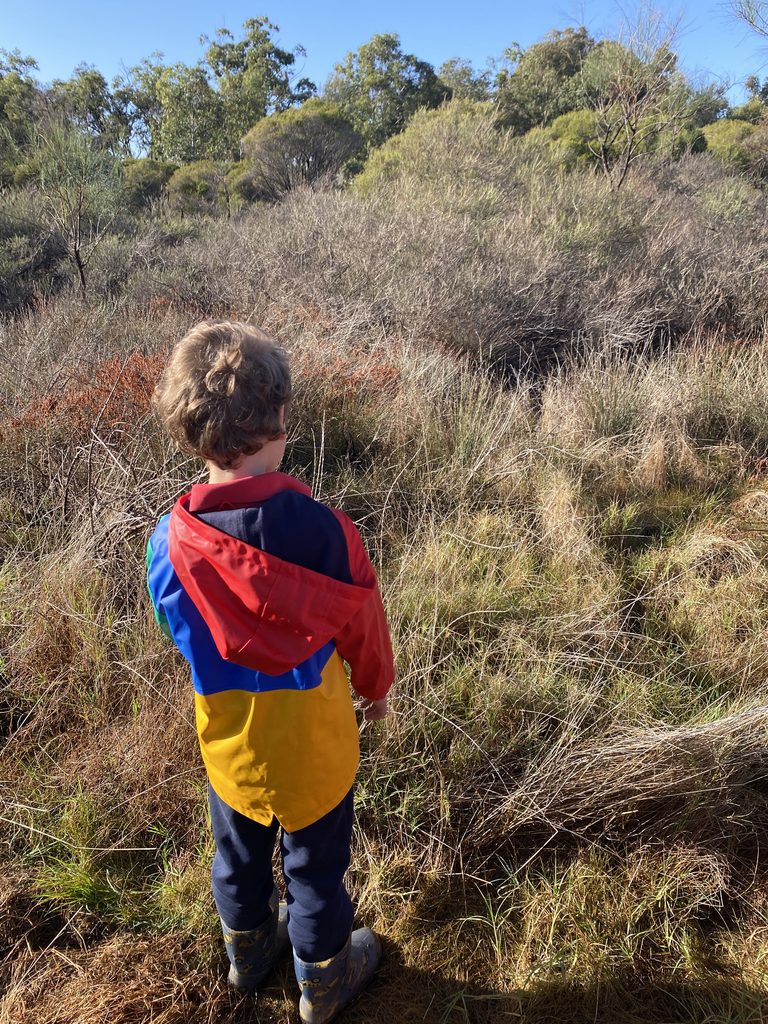
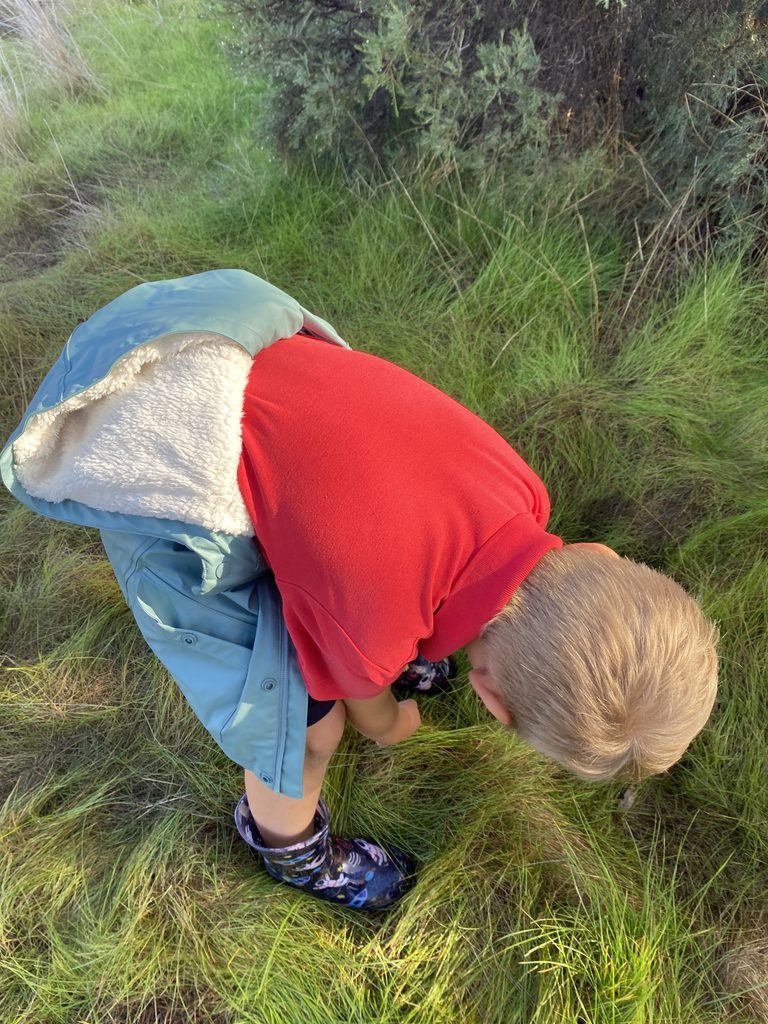
A similar pattern emerged at another school where we were exploring a local wetland over six weeks. During the first few visits, many children stayed close to adults or moved through the landscape cautiously. A golden orb spider landing unexpectedly on a child’s shoulder became a story that was retold week after week, sparking an ongoing fascination with spiders, webs and the creatures that lived within them.
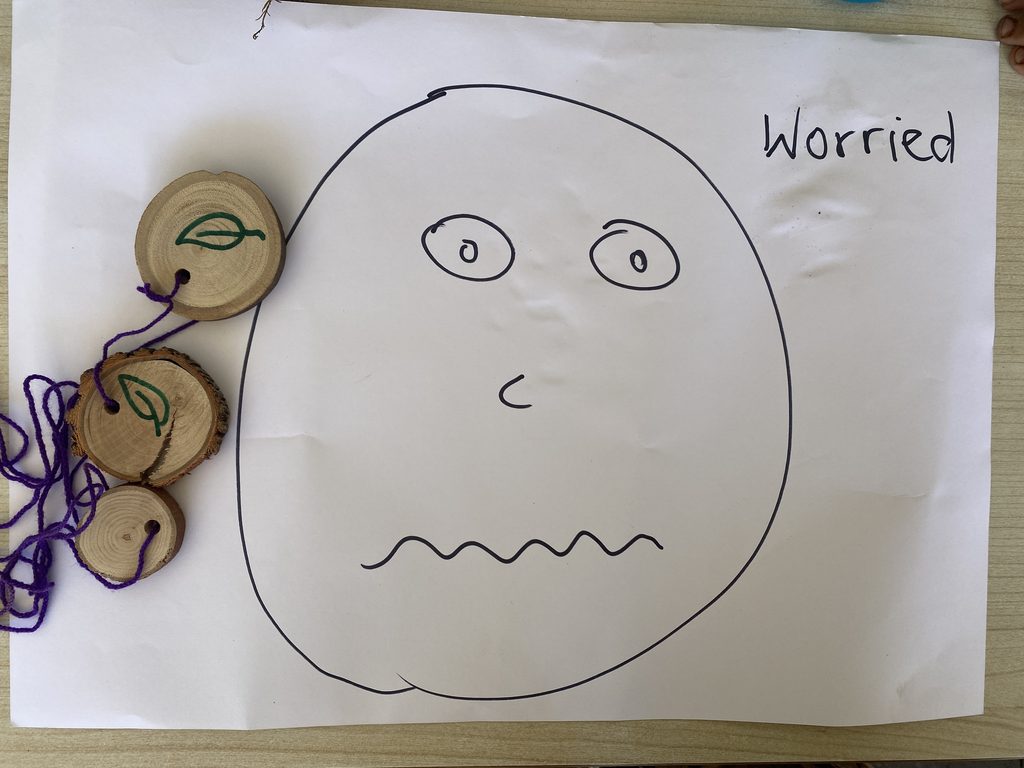
At the end of each session, we invited children to reflect on how they felt in the wetland. Some described feeling peaceful and happy, while others continued to describe feelings of worry or fear. As we listened more closely, however, something interesting emerged.
The children spoke about the “spooky tree” and the “spooky noise.”
The spooky tree was a paperbark. The spooky noise was eventually identified as a moaning frog.
The Appeal of the Spooky
What stood out was that the children did not seem eager to remove the spookiness from these places. Instead, they seemed deeply engaged by it. The paperbarks invited questions about what lay beyond them. The frog calls prompted children to investigate where the sounds were coming from and who might be making them.
There was caution present, but there was also excitement. This exhilaration that contains both fear and joy is something that children often seek out. Through this experience, we found ourselves wondering whether children are also often drawn to the edge between knowing and not knowing.
The following week, we decided to lean into the mystery rather than explain it away.
We added the spooky places to our maps. We talked about paperbark trees and shared some of the many ways Noongar people have traditionally used them, including for shelter, carrying materials and medicine. The children carefully considered which trees might be healthy enough to share a few leaves for smelling and exploring. We experimented with frog calls and listened for different sounds within the wetland.
Familiarity and Mystery
Familiarity and mystery do not sit in opposition to one another, they are complementary partners in learning. As children’s knowledge of the wetland grew, their curiosity grew too. The landscape became more familiar, yet it continued to hold questions.
Research offers some useful insights into what we were observing. Studies exploring children’s curiosity suggest that curiosity is often sparked by an awareness that there is something we do not yet know but could potentially discover. Psychologists describe this as an information gap, the space between what we know and what we want to know.
The tiny hole in the log held an information gap.
The frog call in the reeds held an information gap.
The paperbark grove disappearing into the distance held an information gap.
Perhaps this is part of what makes these experiences so compelling.
Curiosity and the Information Gap
Curiosity researchers suggest that children are often motivated to explore when they become aware of a gap between what they know and what they could potentially discover. Rather than being a problem to solve immediately, the unknown can become an invitation to investigate, observe and ask questions (Liquin et al., 2024).
Research exploring children’s responses to uncertainty has reached similar conclusions. When children feel supported and capable, uncertainty can become a source of exploration rather than avoidance. Many children actively seek opportunities to investigate situations that contain elements of mystery, possibility and incomplete information, engaging with uncertainty through observation, experimentation and play (Blanco et al., 2024).
As we reflected on the children’s experiences in the wetland, we found ourselves wondering whether this was part of what we were witnessing. The mystery of the hole, the sound and the paperbark grove seemed to offer something more than a question waiting to be answered. They created a space where children could linger at the edge of knowing, allowing curiosity to guide what happened next.
The Challenge of Not Yet Knowing
This idea connects closely with the work of Norwegian researcher Ellen Sandseter, who describes how children are often attracted to experiences that feel both exciting and slightly frightening. She uses the term “scary-funny” to describe the mix of emotions children experience when they encounter challenge, uncertainty and adventure in manageable ways.
As educators, we often think about risk in terms of physical experiences such as climbing, balancing or moving at speed. We found ourselves wondering whether there might be another form of challenge present in these encounters.
The challenge of uncertainty and the challenge of not yet knowing. The challenge of standing beside a dark hole, hearing a mysterious sound or peering into a landscape that feels unfamiliar, and deciding to investigate anyway.
At the Edge of the Unknown
Our hope is that children continue to encounter places that hold this kind of possibility. Places that invite observation before explanation. Places that encourage questions before answers. Places where mystery can sit comfortably alongside understanding.
Because perhaps part of developing a relationship with the living world is learning that not everything needs to be immediately known. Sometimes curiosity grows in the spaces between certainty and uncertainty, and it is there, at the edge of the unknown, that some of the most meaningful learning begins.
References
Text Blanco, N. J., Slobodkin, Y., & Thompson, V. A. (2024). Children’s engagement with uncertainty and curiosity. Journal of Cognitive Psychology.
Liquin, E. G., Metz, S. E., & Lombrozo, T. (2024). What Is Curiosity? Nature Reviews Psychology, 3, 497–512.
Sandseter, E. B. H. (2026). Children’s Risky Play—Thrilling Experiences and Developmental Benefits. Journal of Motor Learning and Development, 14(1).