

At the end of each KIN Village session, after all the children have departed, the team of Playworkers gather to debrief the day. We discuss the highlights, the challenges and anything we might approach differently throughout the remainder of the holidays. Playworkers can request particular types of training and, most importantly, we all share gratitude for one another.
This reflective practice is an integral part of the Natural Cycle from the Art of Mentoring model. It helps us reflect on and integrate what we observed and how we responded throughout the day. Our Lead Facilitators then call another senior member of the team to continue the debrief during their journey home. During these holidays, I had many of these calls with Isaac, our Operations Manager and KIN Village coordinator. Together, we discussed the culture that has been forming among KIN Villagers over the past few years.
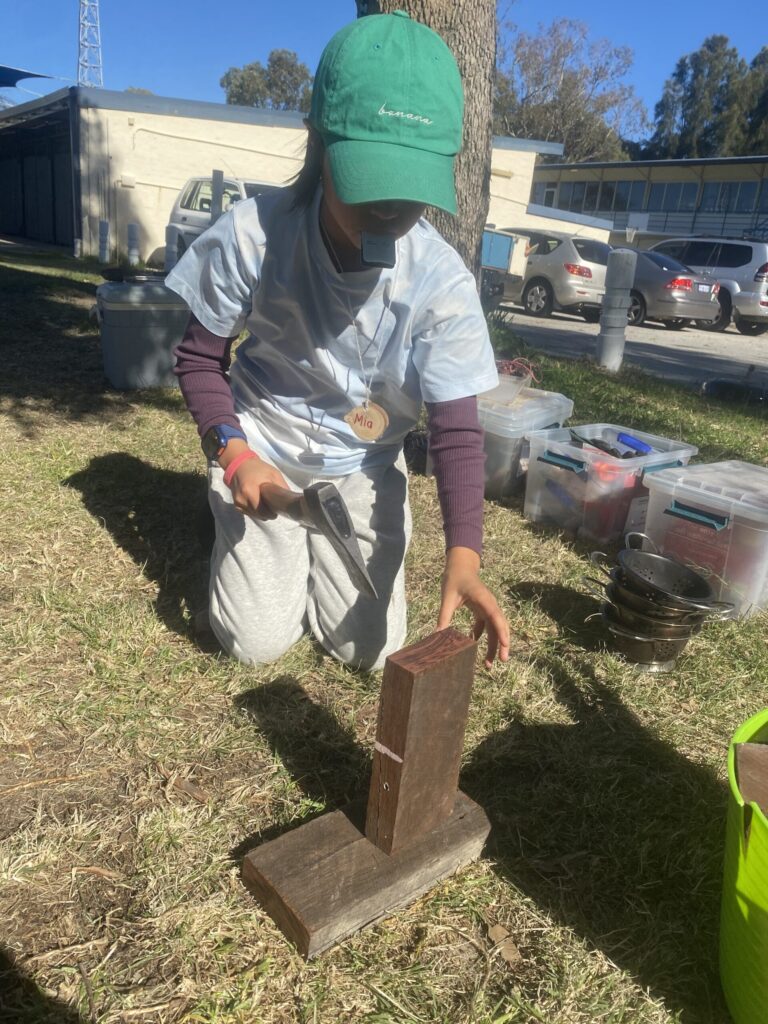
Isaac and I were reflecting on the children who had stepped forward to become Fire Keepers throughout the holidays. At the beginning of one KIN Village day, Mia approached Isaac with a request.
“One child, who has been attending KIN Village since she was six and turns 11 this week, came up to me right at the start of the day and said, ‘Okay, when we do the fire, can I be one of the Fire Keepers and look after the fire?’”
When it was time to light the fire, another, who had also attended KIN Village several times, joined her. Together, they began mentoring an older girl who was newer to the program and wanted to become involved. The three children problem-solved as they started the fire and then cared for it throughout most of the day. They even worked with other children to split the firewood using a hatchet.
The role had not been assigned during the morning briefing. They already knew it existed. Perhaps they had held the responsibility previously or watched other children undertake it. They understood what needed to happen and felt ready to contribute.
We found ourselves wondering how much of the culture of KIN Village is held by the children who return.
The Energy Children Bring
Each KIN Village day has familiar rhythms. Children arrive, explore the site and gradually find their way into cubbies, tools, fire, games and conversations. There are gatherings and shared sausages in winter. At the conclusion of the day, the whole group comes together to pack away the day’s creations.
Within that familiar rhythm, every day feels different.
One session included 20 first-time KIN Villagers within a group of 33 children. Throughout the day, there were many questions. Children wanted to know when they could cook sausages, when they could eat, what would happen next and, repeatedly, what time it was.
We wondered whether the questions were partly about trying to understand an unfamiliar place. Many children are accustomed to days organised by bells, timetables and adults announcing each transition. KIN Village offers a different experience. Children can eat when they are hungry, move between play spaces and follow an idea for much longer than a scheduled activity might usually allow. Some children find this challenging, and it is also something that parents value about the program.
Reflecting on the day with Isaac, I said, “I really feel strongly that we’ve been able to let go of a lot of the briefing with the children in the morning because we’ve had so many returning KIN Villagers who hold the culture of this day.”
Were experienced KIN Villagers quietly answering the questions of newer children? Were they showing others what happened next through their actions? Was it, as we wondered, “just a vibe that’s contagious”?
A few days later, approximately two-thirds of the children had attended KIN Village previously. There were fewer questions about time. During the morning gathering, I tried something different. I pointed out where the sun might be when sausages were cooked and where it might have moved by pack-up and marshmallow time.
The returning children already seemed to understand the rhythm. As Isaac reflected, “It makes a big difference.”
From Separate Cubbies to One Community
The influence of returning children can be subtle. Sometimes it appears through a clearly held role, such as becoming a Fire Keeper. At other times, it is felt through the way play changes across the day.
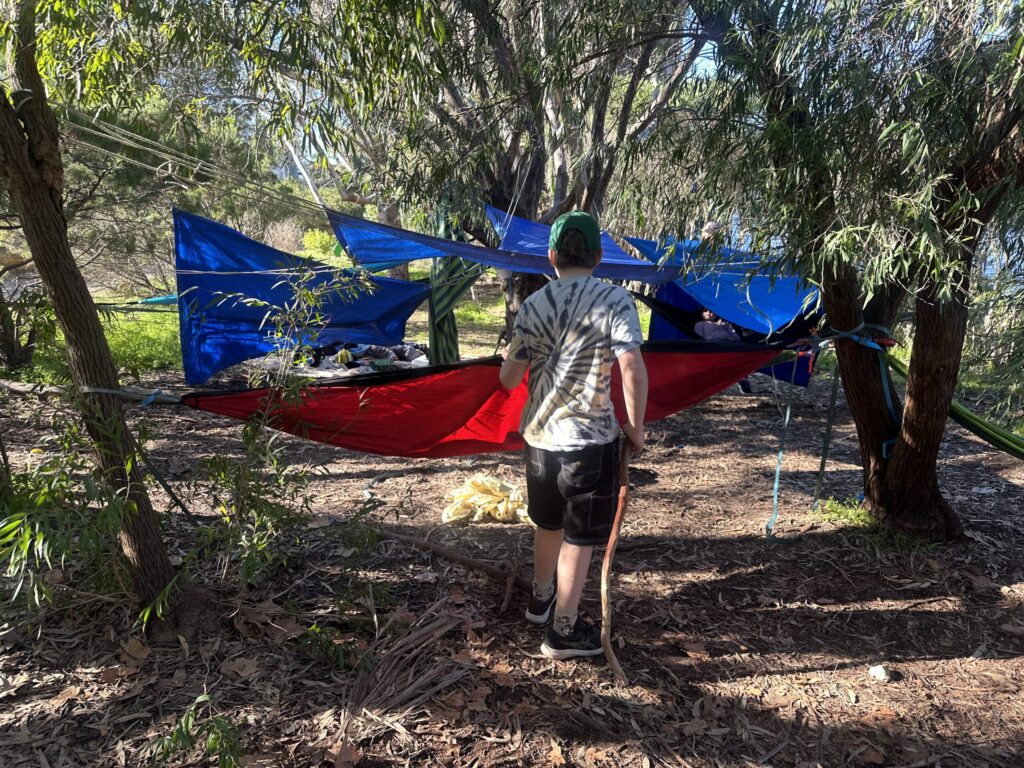
After one KIN Village day, Isaac shared that the cubby area had begun with many small, separate spaces. Each group had its own hammock, structure and ideas. As the day unfolded, children moved between the cubbies. Hammocks that had initially been closely guarded began to be shared. Children who had finished building remained nearby while others entered the spaces they had created.
“By the end of the day, it was really one big community in there,” Isaac observed.
We wondered what had allowed that change of cubby community to happen. Perhaps the children found their own way towards greater generosity. Perhaps Kezia, the Playworker present in the cubby space, had offered small moments of encouragement. Both may have contributed. The Playworkers had created and held the conditions for play, while the children shaped what the community became.
Knowing the Feel of the Place
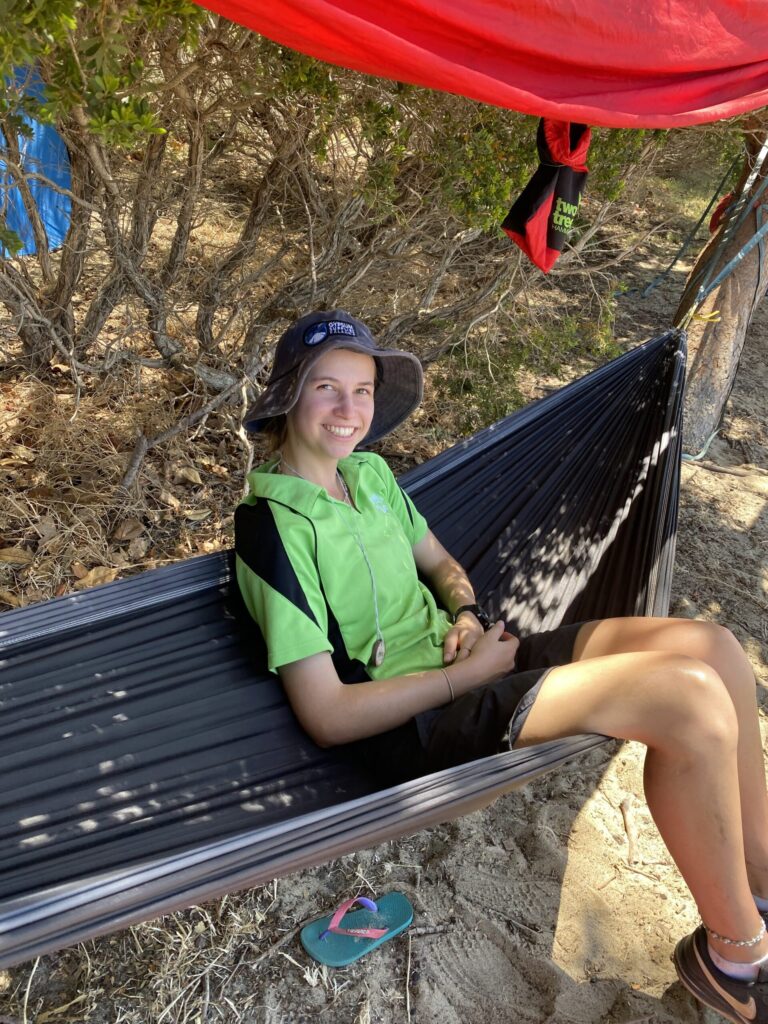
This culture also lives within our youngest Playworkers. Some first attended KIN Village as children, returned as volunteer Junior Mentors and were later employed as Junior Playworkers.
Their pathway gives them a particular kind of familiarity. A Junior Mentor who has spent years within KIN Village can often describe the flow of the day without needing to check. They know what to notice, where help may be required and how the energy changes as play grows, settles or moves in a new direction.
While reflecting on the “magic” one young Playworker, Lily, brings to cubbies, I began to wonder whether her presence comes from knowing the space so deeply. Lily does not need to remain inside her own thoughts, asking what a staff member should be doing or what she should notice.
“She’s just there, and being,” I told Isaac.
Her presence carries knowledge as well as “the story of the energy of the place.” She has her own memories of the cubbies, games, relationships and stories that came before, both as a participant and as a Junior Mentor. She knows the feel of KIN Village and can hold that feeling within herself.
Children seem to recognise this. There is something naturally magnetic about a young person who understands their play, can enter it without taking it over and feels comfortable within its changing energy. These young Playworkers are more present and centred within themselves, leaving them more open to connection.
That capacity continues to grow through mentoring. Rahni practises tending the fire and leading a marshmallow demonstration with Sam’s support. Jack demonstrates how he introduces fire while Sam watches. Molly learns to read when the energy of pack-up is beginning to fade and when the group needs to gather. Junior Playworkers explore how to capture attention, project their voices and sense when energy needs to rise, settle or find a new direction.
The children who return help newer children understand how to be within KIN Village. Some later become Junior Mentors, and some eventually join our team of Playworkers. Each carries part of the culture forward.
Our hope is that a child arriving for the first time feels this culture around them, even before they fully understand it. Perhaps they begin by asking what happens next. With time, they may become the child who knows where to find the marshmallow sticks, welcomes someone into a hammock, keeps the fire or shows another child how the day flows.
Our KIN Village school holiday program is a welcoming space for both new and returning children. We now also offer a session especially for teenagers, created in response to members of our community who did not want to stop attending when they turned 13.
KIN Village Holiday Programs
For more information or to book a place at our next KIN Village, click the link below.